Pedestrian Crossings
Master the rules, approach routines, and safety disciplines for zebra, pelican, puffin, toucan, and pegasus crossings, including zig-zag markings, priority laws, and protecting vulnerable road users.
Stuck on a term or acronym?
Look up DSSSM, MSPSL, clutch bite and more in plain English in the Jargon Buster.
Knowledge: Crossing Types, Statutory Priority, and Road Markings
Pedestrian crossings are controlled areas of road designed to let vulnerable road users cross safely. The UK uses six distinct crossing types: Zebra crossings (black and white stripes across the carriageway flanked by flashing yellow Belisha beacons; drivers must give way once someone has stepped onto the crossing, and under Highway Code Rule 195 should also give way to people waiting to cross), Pelican crossings (signal-controlled with pedestrian push buttons, high-level green/red figures across the road, and an exclusive flashing amber phase where you must give way to pedestrians already on the crossing and do not move off until the crossing is clear of pedestrians; once it is completely clear you may proceed without waiting for green), Puffin crossings (Pedestrian User-Friendly Intelligent crossings, equipped with infrared and optical sensors, roadside push-button indicator units with red/green figures at eye level, and no flashing amber phase; the lights change directly from red to red-and-amber together before green), Toucan crossings ('Two-can cross' for pedestrians and cyclists sharing the space, allowing cyclists to ride across lawfully), and Pegasus crossings (equestrian crossings with high-mounted push buttons reachable on horseback alongside standard pedestrian buttons). In addition, school crossing patrols (lollipop ladies and men) are a person-controlled crossing where you must stop when they show the 'STOP - Children' sign, and workmen or builders on a building site can also control traffic. White zig-zag markings protect the approach and exit zones of crossings: parking or waiting within them is strictly forbidden, and overtaking on the zig-zag lines on the run-up to a pedestrian crossing is strictly illegal under any circumstances. Furthermore, you must never stop or wait on a crossing itself; stopping on a crossing can result in a serious or dangerous fault and an instant driving test failure.
Understanding: Anticipation, Vulnerability, and Why We Never Wave
Crossing zones demand heightened anticipation because pedestrians are fragile, unpredictable, and easily hidden from view by street furniture, parked vehicles, or queuing traffic. Approaching with your right foot covering the brake pedal (holding it over the pedal without pressing) removes your reaction time delay if a pedestrian steps out suddenly. Waving pedestrians across is a dangerous and test-failing error: your signal gives a false sense of security, encouraging them to step forward without checking other lanes, overtaking cyclists, or motorcycles filtering through gaps. Similarly, overtaking on the zig-zag lines on the run-up to a crossing is banned by law because an overtaking vehicle blocks visibility of pedestrians stepping out and eliminates any buffer of safety. When traffic queues ahead, drivers must never stop, wait, or queue across a pedestrian crossing: coming to a halt on a crossing obstructs pedestrians, forces them to weave dangerously between stationary cars, and constitutes a test-failing error. Always leave the crossing area completely clear.
How to Spot a Pedestrian Crossing Before You Reach It
Early recognition gives you time to check your mirrors, reduce your speed smoothly, and scan both pavements before deciding whether to stop. Scan ahead for these five clues in order, from early advance warnings and road markings to signals and pedestrian movement at the kerb.
1. Red triangle warning sign
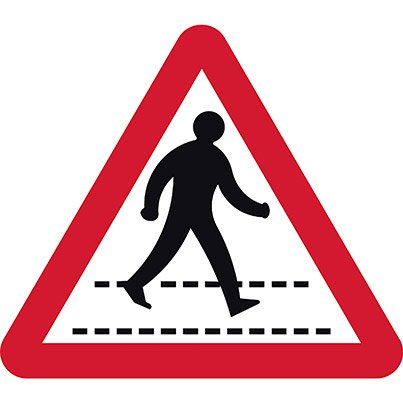
On higher-speed roads, rural sections, or where visibility is limited, an advance warning sign alerts you to a crossing ahead. Look for a standard triangular road sign with a red border showing one walking figure stepping over crossing stripes.
This sign is often used when the crossing is round a bend or corner, or is otherwise obstructed from view. However, not all crossings have an advance warning sign, so you must also identify crossings by other clues: flashing yellow beacons on a zebra crossing, traffic lights or push-button controls (pelican, puffin, toucan, pegasus), and white zig-zag lines on the road surface.
When you spot this sign, perform an interior mirror check, ease off the accelerator, and prepare to identify the crossing ahead.
- Red-bordered triangle showing one pedestrian walking across stripes
- Frequently used when a crossing is hidden round a bend, over a crest, or obstructed by trees and buildings
- Not all crossings have a sign: always look out for beacons, lights, and zig-zag lines
2. Zig-zag lines on the run-up to the crossing
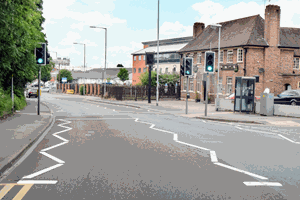
White zig-zag lines painted on the road surface are often the very first clue you see on the approach. They appear along the kerb and down the centre of the road on both the approach and departure sides of zebra and signal-controlled crossings.
Seeing zig-zag lines tells you immediately that a crossing is imminent. Remember the strict legal rule: you cannot overtake on the zig-zag lines on the run-up to a pedestrian crossing, and you must never park or wait on them.
- Often the first clue visible on the road surface as you approach
- Strict legal ban: you cannot overtake on the zig-zag lines on the run-up to the crossing
- No stopping, parking, or waiting within the zig-zag markings at any time
3. Belisha beacons and flashing yellow globes
For zebra crossings, flashing yellow or amber globes (Belisha beacons) mounted on black-and-white striped posts are visible from several hundred yards away, particularly at night or in overcast weather.
Look high and wide along both pavements and on any central island. Some modern zebra crossings also feature reflective posts or illuminated halo rings to maximise advance prominence.
- Bright flashing yellow/amber globes at either side of the road and on central pedestrian refuges
- Distinctive black-and-white painted poles supporting each beacon
- Visible long before the painted road surface stripes come into view
4. Traffic lights and push-button controls
For signal-controlled crossings (pelican, puffin, toucan, pegasus), look for upright black posts carrying signal heads, push-button control boxes, or overhead mast arms.
Seeing the pedestrian push-button box or the amber/red aspect of a traffic light allows you to anticipate a change. The pavement edges will also show textured tactile paving (usually raised blisters) leading to the crossing point.
- Standard traffic signal heads or overhead mast arms spanning the lane
- Pedestrian push-button control boxes mounted at waist height on signal poles
- Contrasting tactile blister paving extending to the kerb edge
5. Pedestrians on pavements and queuing traffic behaviour
Look for people walking towards the kerb, standing near the crossing threshold, looking across the street, or wearing headphones and looking down at phones. Anticipate children who may run forward without checking.
Watch following and oncoming traffic: brake lights illuminating on vehicles ahead, or approaching oncoming cars slowing down, indicates that a pedestrian has started to cross or that a signal change has occurred.
- Pedestrians approaching the kerb edge or holding children's hands
- Guide dogs, white canes, wheelchairs, or mobility scooters nearing the tactile paving
- Brake lights illuminating on vehicles ahead in your lane or oncoming traffic slowing to a halt
As soon as you spot any of these five clues, apply the MSPSL routine: check your interior mirror to gauge following traffic, ease off the gas, cover the brake, and scan both sides of the road.
Informal Crossings, Refuges and Islands
Alongside formal marked crossings, roads frequently feature informal crossing points and pedestrian refuges. Knowing how to deal with them correctly is crucial for driving safety and your practical test.
Pedestrian Refuges and Traffic Islands
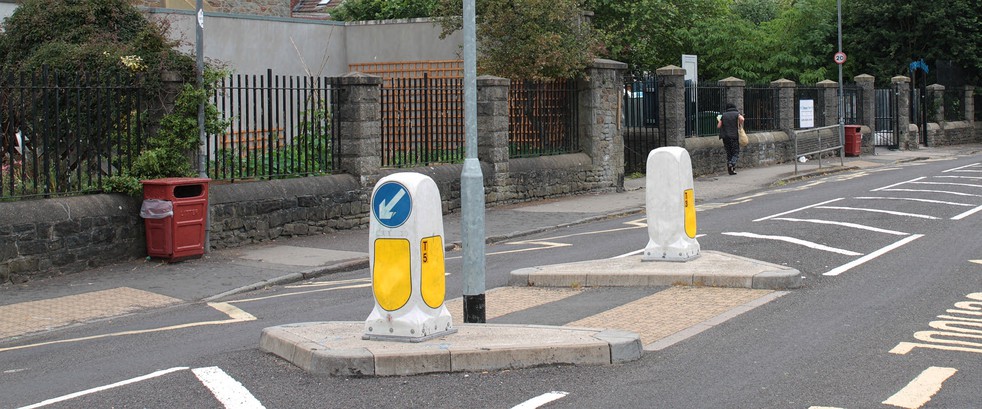
A pedestrian refuge is a raised island in the centre of the carriageway, often protected by illuminated bollards, designed to let pedestrians cross the road in two separate stages.
Do NOT stop for someone waiting at a refuge or island: on the driving test you are not expected to wait. Stopping unexpectedly is dangerous because traffic behind may not anticipate your stop and could run into the back of your car, causing an accident.
However, you must always stay alert and be ready to stop if someone misjudges traffic and steps out into the road in front of you. Always cover your brake and monitor their body language.
- Do NOT stop for a pedestrian waiting at a central refuge or island
- On the driving test, you are not expected to stop for people waiting at an island
- Traffic behind does not expect you to stop and could rear-end your vehicle
- Always be prepared to stop if a pedestrian actually steps out onto the carriageway
Informal Crossings and Dropped Kerbs
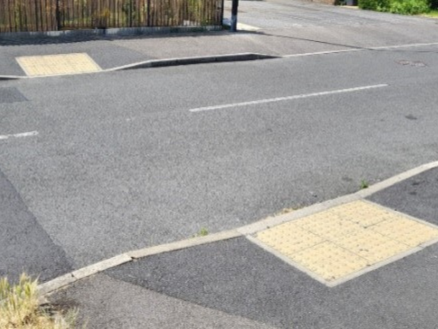
Informal crossings typically consist of dropped kerbs with tactile paving on opposite sides of the road, without road markings, beacons, or traffic lights. They help wheelchair users, pushchairs, and pedestrians cross where formal facilities are absent.
Treat informal crossings like any normal stretch of road: maintain your lane and normal progress if nobody is in the road. Do not stop to wave pedestrians across. However, under Highway Code Rule H2, if a pedestrian has already started to cross the road you are driving along, they have priority and you must give way.
- Dropped kerbs and tactile paving without striped markings or traffic lights
- Do not stop to beckon or wave waiting pedestrians across
- Give way if a pedestrian has already begun crossing into your path
On your driving test, stopping when you have priority to let someone cross from an island or informal crossing can result in a serious fault for undue hesitancy or causing danger to vehicles behind.
Comparing the Six UK Crossing Types
Each crossing type has specific operating mechanisms, light sequences, and priority rules under the Highway Code. Understanding their differences is essential for both your driving test and daily road safety.
Zebra Crossing
A zebra crossing is marked with alternating black and white stripes across the road surface and flashing yellow Belisha beacons on striped posts on both pavements (and on any central island).
Under Highway Code Rule 195, you must give way once a pedestrian has stepped onto the crossing. The updated Highway Code also advises drivers that they should give way to pedestrians waiting to cross at the kerb edge. Look well ahead to give yourself and following traffic plenty of time to stop smoothly.
When a zebra crossing is divided by a central island, each side is a separate crossing. You only have to give way to people on, or waiting to step onto, the half you are driving towards. If nobody is crossing on your side, you can continue to drive even if someone is on the other half.
- Flashing amber Belisha beacons; black-and-white road stripes
- Must stop once someone steps onto the crossing; should give way to people waiting
- Divided by a central island: each side is a separate crossing; keep driving unless someone is crossing on your side
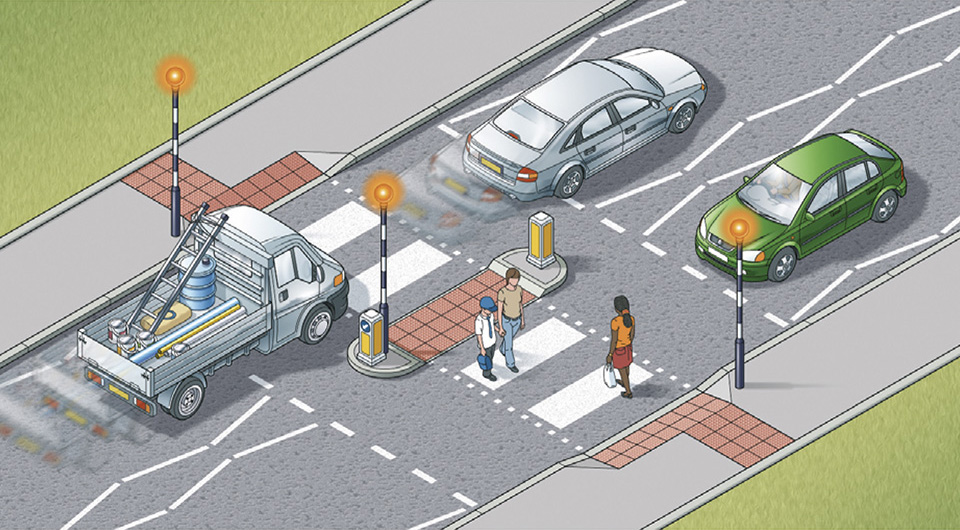
Pelican Crossing
Pelican stands for Pedestrian Light Controlled crossing. It uses standard traffic lights operated by pedestrian push buttons. The pedestrian figures (red and green man) are mounted on the far side of the road, opposite the pedestrian.
Pelican crossings have an exclusive flashing amber light phase for drivers. During flashing amber, you must give way to pedestrians already on the crossing and do not move off until the crossing is clear of pedestrians; once it is completely clear you may go without waiting for green.
Some pelican crossings are staggered, with the two halves offset around a central island. When a crossing is staggered it is two separate crossings, so treat each half on its own and go when your half is clear.
- Push-button operated with far-side pedestrian signal heads
- Exclusive flashing amber phase: give way to pedestrians already on the crossing; do not proceed until the crossing is clear
- Once completely clear of pedestrians, you may go without waiting for the green signal
- Staggered crossing: two separate crossings, one for each carriageway
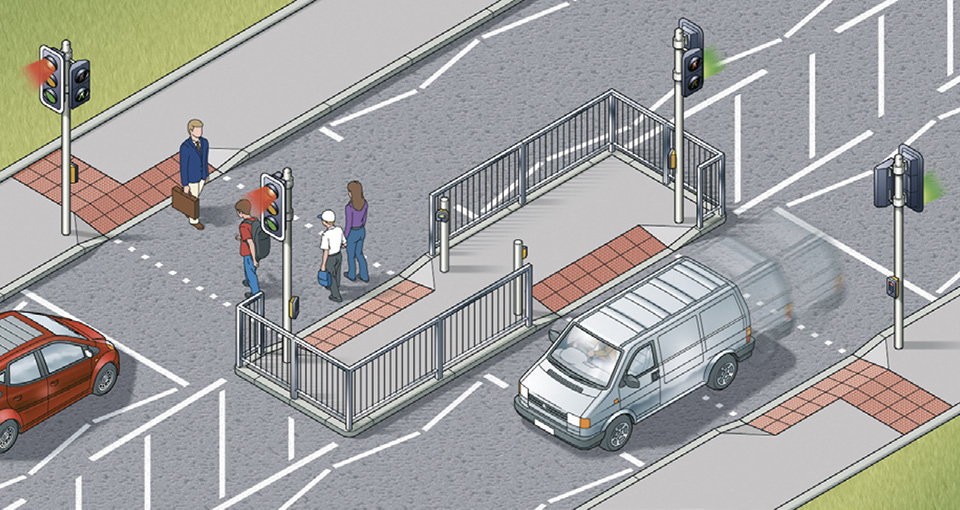
Puffin Crossing
Puffin stands for Pedestrian User-Friendly Intelligent crossing. It is the modern replacement for the pelican crossing and uses smart technology to adapt to pedestrian movements.
The red and green pedestrian figures are located on the push-button control box on your side of the road at eye level, not across the carriageway. Infrared and video sensors detect pedestrians on the crossing and hold the red light until they have reached the opposite pavement safely, speeding up crossing times for brisk walkers and giving extra time to elderly or less mobile people.
Puffin crossings do NOT have a flashing amber phase. The lights follow the standard UK traffic signal sequence: red, then red-and-amber together, then green.
A staggered puffin crossing is also two separate crossings: obey the signals for your own half of the road.
- Smart optical and infrared sensors monitor crossing width
- Pedestrian lights located on near-side push-button box at eye level
- No flashing amber: changes from red to red-and-amber, then green
- Staggered crossing: two separate crossings, one for each carriageway
Toucan Crossing
Toucan stands for 'Two-can cross': both pedestrians and cyclists are lawfully permitted to cross side by side. Cyclists do not have to dismount.
Toucan crossings are wider than standard crossings and connect cycle routes, shared-use paths, or bridleways across busy roads. The signal heads display both a green pedestrian figure and an illuminated green bicycle symbol.
Approach toucan crossings with extra vigilance for fast-moving cyclists who may approach from behind hedgerows or side paths at speed.
- Allows both cyclists and pedestrians to cross together legally
- Shared-use paths connecting to the crossing; wider crossing area
- Pedestrian and bicycle symbols displayed on signal heads
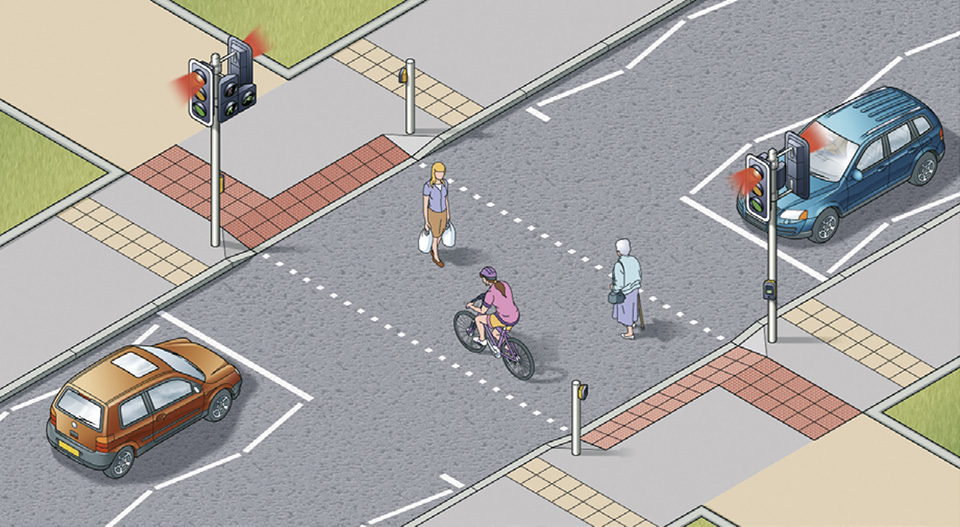
Pegasus Crossing
A pegasus crossing (also known as an equestrian crossing) is designed for horse riders as well as pedestrians. They are typically found near commons, parks, bridleways, and racecourses.
Pegasus crossings feature an additional push button mounted high up (around two metres) so a rider can press it without dismounting, alongside a lower button for pedestrians. The signal aspect displays a green horse and rider symbol.
Keep engine noise low, avoid revving, do not sound your horn, and allow generous clearance when horses are crossing, as sudden movements or loud noises can easily spook them.
- High-mounted push button for horse riders plus standard lower button
- Horse and rider symbol on crossing signal head
- Drive quietly, never rev the engine, and give horses wide berth
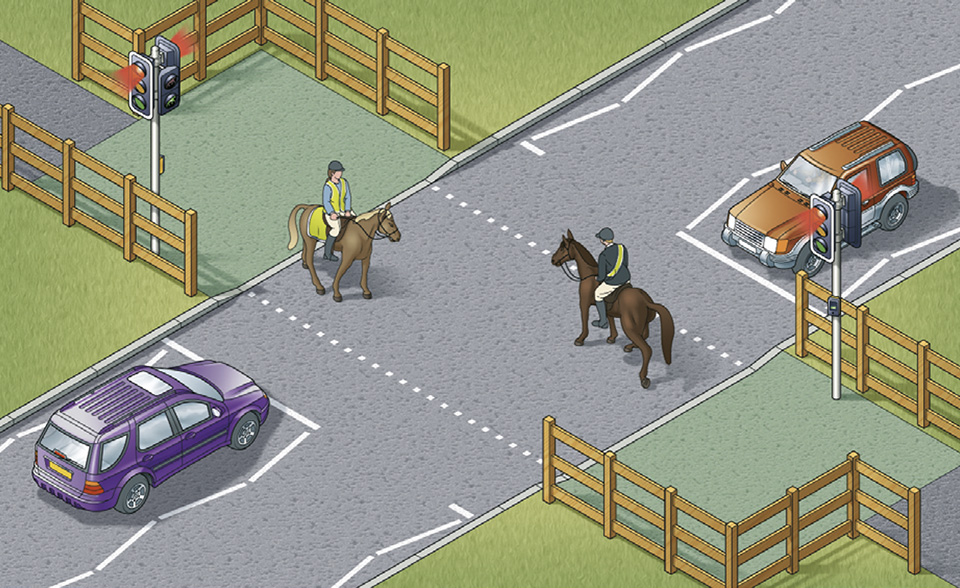
School Crossing Patrol (Lollipop Person)
A school crossing patrol, often known as a lollipop lady or man, is a controlled crossing run by a person rather than by automatic lights or road markings. They wear high-visibility clothing and hold a distinctive circular 'STOP - Children' sign on a pole.
When a school crossing patrol steps into the road and displays the sign, you must stop. It is a strict legal instruction under Highway Code rule 211, carrying the same legal force as a police officer's signal. Stop before the crossing line or where indicated, and remain completely stationary until they have returned to the pavement and lowered the sign. Never wave anyone across, edge forward, or attempt to overtake.
Crossings and traffic flow can also be controlled by other authorised people, such as workmen or builders at a building site or roadworks holding a stop/go board or directing traffic. Follow their instructions in the same way, approaching slowly and waiting with patience and care.
- Human-operated crossing controlled with a circular 'STOP - Children' sign
- Must stop immediately when the sign is displayed; it is a strict legal instruction
- Remain stationary until the patrol returns to the pavement and lowers the sign
- Workmen or builders at a building site or roadworks can also direct and control traffic
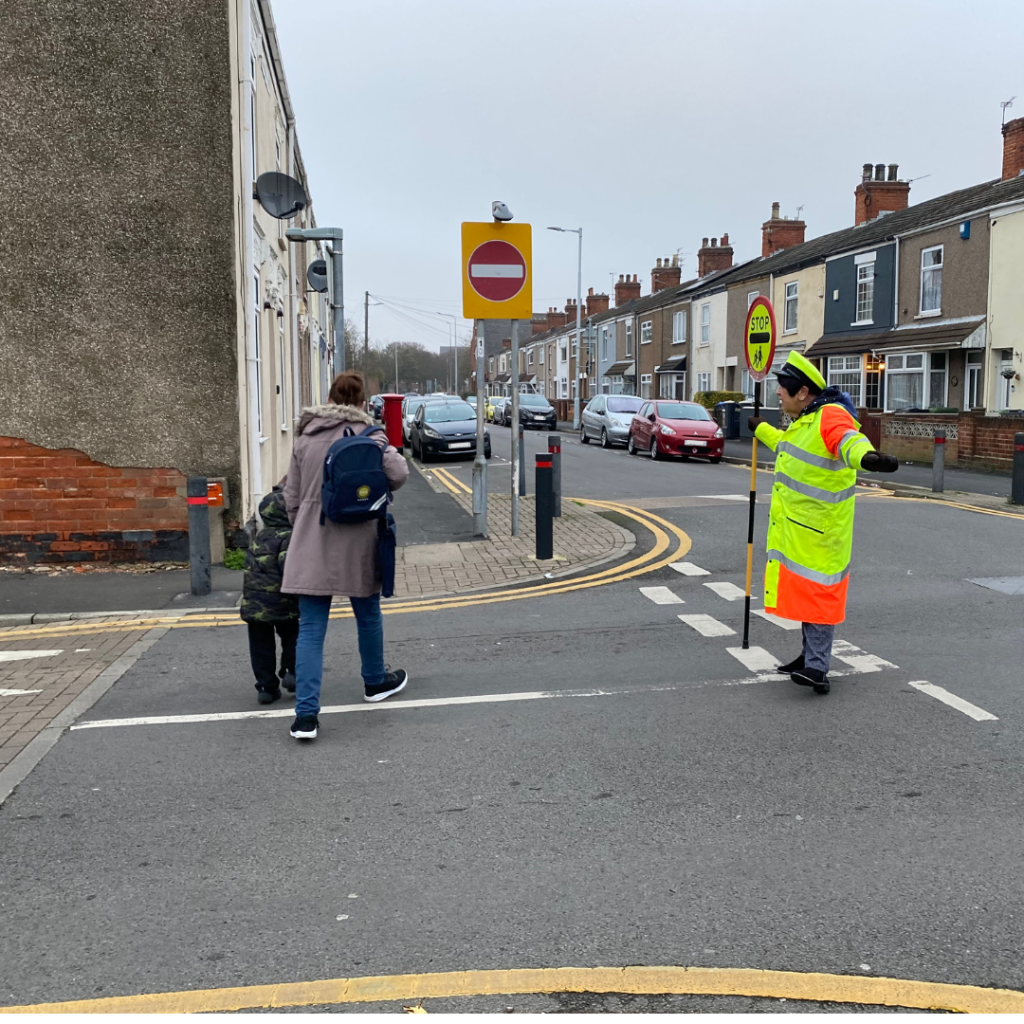
Always remember: regardless of crossing type, if someone is on the road in front of you, you must stop safely and wait.
Syllabus, Highway Code & Test Requirements
How this lesson aligns with the official national driving standards and practical test assessments in Great Britain.
- Identify all six UK pedestrian crossing types early and understand their operational differences and priority rules.
- Apply the MSPSL routine on approach, checking mirrors, regulating speed, and covering the brake when necessary.
- Comply strictly with road markings around crossings, including zig-zag lines, stop lines, and give-way studs.
- Demonstrate patience, avoid waving pedestrians across, and protect vulnerable road users including children, disabled individuals, and horse riders.
Highway Code: Pedestrian crossings (rules 191–199)
Rules covering zebra, pelican, puffin, toucan, and equestrian crossings, zig-zag lines, stationary vehicle overtaking restrictions, and school crossing patrols.
Highway Code: Zebra crossings (rule 195)
You must give way when a pedestrian has moved onto a crossing; you should give way to pedestrians waiting at the crossing edge.
Highway Code: Flashing amber at pelican crossings (rule 196)
At pelican crossings, flashing amber means you must give way to pedestrians already on the crossing and do not move off until the crossing is clear of pedestrians; once it is completely clear you may go without waiting for green.
Highway Code: School crossing patrols (rule 211)
When a school crossing patrol displays the 'STOP - Children' sign, you must stop your vehicle until the patrol lowers the sign and returns to the pavement.
- Driving test assessment under 'Pedestrian crossings', evaluating recognition, approach speed, and safe yielding.
- Driving test assessment under 'Use of mirrors – Signalling / Change of speed' prior to slowing down for crossing pedestrians.
- Driving test assessment under 'Judgement – Meeting / Crossing', ensuring no encroachment on zig-zags or blocking of crossing paths in queuing traffic.
Skills: Hands, Feet, and Eyes at Pedestrian Crossings
Execute the systematic MSPSL routine on every crossing approach. Calm footwork and wide scanning ensure a smooth stop and complete pedestrian safety.
As soon as you identify a crossing ahead or notice pedestrian activity, check your interior rear-view mirror. Note the distance and speed of vehicles behind you so you know how firmly you can brake if the lights change or someone steps out.
Ease off the accelerator early and rest your right foot lightly over the footbrake without depressing it ('covering the brake'). This eliminates the physical delay of moving your foot if an emergency stop or sudden yield is required.
Scan left and right well beyond the kerb line. Look for pedestrians approaching the crossing from behind parked cars, trees, or shopfronts. Check both sides of central pedestrian refuge islands and look out for approaching cyclists or runners.
If a pedestrian is waiting at a zebra crossing, or if a signal has turned amber or red, squeeze the brake pedal progressively. Come to a smooth halt just before the solid white stop line or give-way studs, keeping both hands steady on the steering wheel.
Once stationary, if the wait will be more than a momentary pause, apply the parking brake (handbrake) and select neutral (or hold footbrake firmly). This prevents your car creeping forward or rolling backwards if struck from behind.
Keep your hands on the steering wheel. Never wave, nod, or flash your headlights to invite pedestrians across. Allow pedestrians to decide for themselves when it is safe to cross. Watch for other road users who might not have stopped.
Before moving away when the lights change to green (or when the zebra crossing is completely clear), check both sides of the crossing, your interior mirror, and blind spots. Ensure slow-moving pedestrians or prams have fully cleared the crossing before accelerating.
We recommend a six-point check, including BOB and TOM
Before pulling away at a pedestrian crossing, we recommend a six-point check: left blind spot, left mirror, interior mirror, right mirror, right blind spot, then ahead. In other words, check left and right, and include a blind spot check for BOB (Boy on a Bike) and TOM (Traffic Overtaking Me).
Pedestrian crossings are normally in high traffic flow areas, such as busy town centres, where there are likely to be cyclists and motorcyclists around you. If you have been waiting for a period of time, there is a distinct possibility that cycles, motorbikes or other traffic have come alongside you without you noticing. That is why BOB and TOM matter so much here.
Want to understand the total observations needed when moving away? Lesson A1: Mirrors explains the six-point check in full.
Parked-Car and Visualisation Drill: Crossing Approach Scans
Practise this mental observation routine and footwork discipline while parked safely with the engine off before your next driving lesson.
Practice Steps
Core Essentials & Examiner Criteria
What you must get right every time, paired with what the driving examiner marks on your practical test.
What You Must Get Right
Always check your interior mirror before easing off the gas or braking for a crossing.
Cover the footbrake on approach to every crossing to eliminate reaction delay.
Give way to pedestrians who have stepped onto a zebra crossing, and look for people waiting to cross.
Never wave, nod, or flash your headlights to invite someone to cross.
Never overtake on the zig-zag lines on the run-up to a pedestrian crossing; it is strictly prohibited by law.
Never park, wait, or stop on a crossing or on its zig-zag markings; stopping on a crossing can result in a test failure.
At a pelican crossing, give way to pedestrians already on the crossing; do not proceed until the crossing is clear.
What the Examiner Looks For
Early recognition of crossing types and controlled, progressive approach speeds.
Prompt mirror checks before braking and awareness of traffic following behind.
Strict obedience to traffic light sequences: at pelican crossings, give way to pedestrians already on the crossing and do not proceed until the crossing is clear.
Restraint from waving or signalling pedestrians to cross the carriageway.
Not stopping, waiting, or queuing on a pedestrian crossing, leaving it completely unobstructed at all times.
Compliance with overtaking bans on zig-zags and not stopping unnecessarily for pedestrians waiting at refuges or islands.
Common Mistakes, Test Failures & Safety Tips
Understand how small slips become driving test faults, and how to keep every manoeuvre safe.
Common Learner Mistakes
Waving pedestrians across
Signalling with hands or flashing headlights to tell someone to walk across, which gives false reassurance when other traffic or cyclists may not stop.
Overtaking on zig-zags on the run-up
Overtaking on the zig-zag lines on the run-up to a pedestrian crossing, which is a dangerous and strict criminal offence.
Stopping or blocking a crossing in queuing traffic
Stopping, waiting, or queuing directly over a pedestrian crossing, blocking pedestrian movement and creating a serious test failure.
Stopping for pedestrians waiting at a refuge or island
Stopping unnecessarily to let a pedestrian cross who is waiting at a central refuge or island, risking a rear-end collision from following vehicles.
Treating puffin crossings like pelicans
Expecting a flashing amber phase at a puffin crossing and moving off early on red-and-amber before pedestrians have fully cleared.
Essential Safety Tips
Watch for obscured pedestrians near high vans and buses
High-sided delivery vans, buses, or queuing lorries create massive blind zones near crossings. Small children, prams, and wheelchair users can emerge without advance warning; approach at walking pace until your sightline is clear.
Respect school crossing patrols
School crossing patrols (lollipop wardens) have statutory authority under the Road Traffic Act. When they step into the road and raise the 'STOP - Children' sign, you must stop before the crossing line and wait until they return to the pavement.
Look for visual and mobility impairments
Watch for white canes (indicating visual impairment), red-and-white banded canes (indicating both visual and hearing impairment), and guide dogs. Give visually impaired and disabled pedestrians ample time and patience to complete their crossing.
Be alert for fast cyclists at toucan crossings
Because toucan crossings connect to designated cycle tracks, cyclists can approach the crossing at speed from pathways shielded by hedges or fences. Always scan widely beyond the immediate kerb line.
Common Causes of Test Failure
How driving examiners categorise errors under the DVSA marking system:
Minor (Driving Faults)
Not potentially dangerous, but marked if repeated.
Late mirror check before braking for crossing
Braking smoothly for a red signal or pedestrian but glancing in the rear-view mirror only after foot pressure was already applied.
Stopping slightly over the give-way studs
Stopping safely without endangering anyone, but allowing the front tyres to rest marginally past the broken give-way studs at a zebra crossing.
Serious Faults
Potentially dangerous; results in a test failure.
Stopping on a pedestrian crossing
Stopping, queuing, or waiting directly on a pedestrian crossing, blocking the crossing path for pedestrians and resulting in a test failure.
Failing to give way to a pedestrian on a zebra crossing
Driving over a zebra crossing while a pedestrian has already stepped onto the carriageway, forcing them to pause or step back.
Overtaking on zig-zag lines on approach
Overtaking any moving or stationary vehicle on the zig-zag lines approaching a pedestrian crossing.
Waving a pedestrian across
Gesticulating or waving by hand to encourage a pedestrian to cross, potentially exposing them to unseen oncoming or overtaking vehicles.
Dangerous Faults
Actual danger to you, examiner, or other road users.
Proceeding through red signal while crossing is occupied
Driving through a red light or into an occupied crossing where pedestrians are actively walking, requiring immediate examiner intervention.
Overtaking a vehicle stopped at a pedestrian crossing
Attempting to overtake a car that has stopped at a pedestrian crossing to allow people to cross, creating an imminent collision hazard.
Question 1: What must you do when approaching a zebra crossing where a pedestrian is waiting at the pavement edge?
Question 2: At a pelican crossing, what does a flashing amber light mean for drivers?
Question 3: How does a puffin crossing differ from a pelican crossing?
Question 4: What is permitted at a toucan crossing that is not permitted at standard pelican or puffin crossings?
Question 5: What do white zig-zag lines on the approach and departure of a pedestrian crossing mean?
Question 6: Why is it dangerous and unacceptable on a driving test to wave a pedestrian across the road?
Question 7: When driving in slow-moving or queuing traffic towards a pedestrian crossing, what must you do?
Question 8: A car in the lane beside you has slowed down and stopped at a zebra crossing. What must you do?
Question 9: What is a pegasus crossing primarily designed to accommodate?
Question 10: What does a pedestrian carrying a white stick with a red reflective band indicate?
Question 11: When a school crossing patrol holds up a 'STOP - Children' sign in the road, what is your legal duty?
Question 12: What does 'covering the brake' mean when approaching a pedestrian crossing?
Question 13: At a zebra crossing with a central pedestrian refuge island, how should you treat the crossing?
Question 14: What is the rule regarding overtaking on the zig-zag lines on the run-up to a pedestrian crossing?
Question 15: On your practical driving test, you approach a pedestrian refuge island in the middle of the road where a pedestrian is waiting to cross. What should you do?
Question 16: When approaching a pedestrian crossing in slow-moving traffic, what must you ensure you do not do?
Theory Test Topics for This Lesson
Reinforce what you have learned by practising official DVSA theory test revision questions.
Study triangular warning signs indicating pedestrian crossings ahead, school crossing warnings, and the distinctive symbols used on toucan and equestrian signal heads.
Practice on GOV.UKPay attention to zebra crossings located near side roads, ensuring you do not block crossing paths when queuing to emerge or turn.
Practice on GOV.UKPractise official theory questions regarding white zig-zag line restrictions, the meaning of flashing amber at pelican crossings, and how puffin sensors operate.
Practice on GOV.UK