Crossroads and Staggered Junctions
Master junction priorities, safe speed control using MSPSL, and comprehensive all-round observations. Poor observation at crossroads is a leading cause of collisions and driving test failures—learn to check blind spots on both sides of the car and time your right turns with confidence.
Stuck on a term or acronym?
Look up DSSSM, MSPSL, clutch bite and more in plain English in the Jargon Buster.
Knowledge: Crossroads Types, Staggers, and Priority Principles
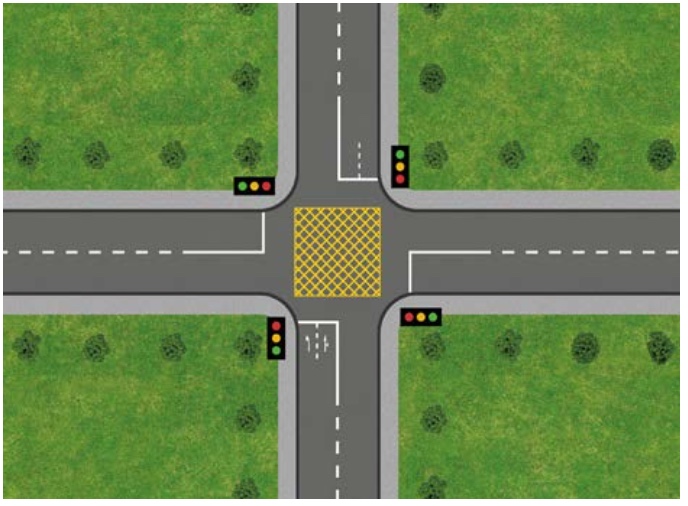
A crossroads is an intersection where four road arms meet. Crossroads fall into four distinct operational types: 1) Uncontrolled crossroads, where there are no traffic lights, road signs, or give-way lines, meaning legally no driver has priority and everyone must approach with extreme caution; 2) Priority crossroads governed by give-way or STOP lines and signs, where traffic on the major road has priority while vehicles on the minor road approaches must yield; 3) Traffic-light controlled crossroads, where multi-phase signals govern movement and dedicated filter arrows may grant protected turns; and 4) Yellow box junctions, where painted criss-cross grids keep the intersection clear of queueing traffic. Staggered junctions occur where side roads are offset from one another—either left-then-right or right-then-left—functioning effectively as two separate T-junctions in close succession. Turning right opposite an oncoming vehicle requires either an offside-to-offside turn (passing behind each other driver's-door to driver's-door, leaving forward sightlines open) or a nearside-to-nearside turn (turning in front of each other passenger-door to passenger-door, which severely restricts forward view).
Understanding: Why Dual-Side Blind Spots and Scanning Save Lives
Observations at crossroads are the single biggest cause of accidents at intersections, and poor observation is consistently one of the most common reasons for failing the UK driving test. Many learners make the fatal assumption that a single glance left or right is sufficient. It is NOT just a left blind-spot check and a right blind-spot check: you must check blind spots on BOTH sides of the car, every single time, and maintain continuous all-round observation (right, ahead, left, right again) before committing. Vehicles, cyclists, and pedestrians can approach from four directions simultaneously. When turning right nearside-to-nearside, the opposing vehicle creates an enormous physical blind spot concealing straight-ahead traffic and filtering two-wheelers. By applying the MSPSL routine (Mirrors, Signal, Position, Speed, Look) early and cycling through LADA (Look, Assess, Decide, Act), you build the spatial awareness required to prevent collisions and avoid hesitation.
How to Spot a Crossroads Before You Reach It
Spotting a crossroads early gives you the time needed to apply MSPSL calmly. When driving along any road, scan well ahead and look for these five clues that indicate a four-way intersection is coming up.
1. Road signs
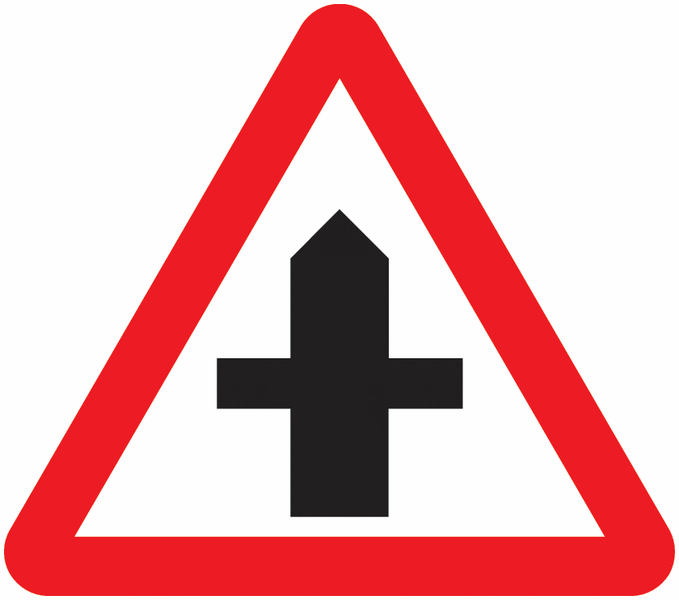
Look for a red-bordered triangular warning sign showing a bold black plus-shaped crossroad symbol. As you draw closer, watch for Give Way signs (an upside-down triangle), octagonal red Stop signs, or advance warning plates such as 'Give Way 50 yds' or 'Stop 100 yds'. On busier routes, look out for the traffic signal warning triangle (red, amber, green circle symbol) and the traffic light heads themselves mounted high on posts.
2. Gaps in buildings
Scan the building line on BOTH sides of the road ahead. At a crossroads, you will notice openings or breaks in the line of houses, hedges, boundary walls, and fences on both the left and right at roughly the same point, with the road continuing straight ahead beyond. If the gaps are offset rather than directly opposite, you are approaching a staggered junction.
- Look for gaps in the building or fence line opening on both sides simultaneously
- Notice street light columns, telegraph poles, or side-road street name plates visible through the gap
- At staggered junctions, watch for one gap on the left and another slightly further along on the right (or vice versa)
3. Road markings
The tarmac provides immediate clues before you can even see the junction mouth. Watch for changes in lane markings and approach lines.
- Hazard warning lines: the white dashes dividing the carriageway become noticeably longer with much shorter gaps between them
- Double broken white lines across side-road mouths indicating Give Way lines, or a solid white line accompanied by the word STOP
- Double yellow lines curving smoothly around both corner radiuses into the side mouths
- Directional painted arrows and lane divider lines guiding traffic into left, right, or straight-ahead lanes
- Yellow criss-cross box grids painted directly in the centre of the intersection
- Solid white stop lines positioned at signal-controlled junctions
4. Cars entering and leaving
Monitor the flow and behaviour of traffic ahead. Vehicles moving perpendicularly or decelerating indicate where side arms meet the main road.
- Vehicles crossing horizontally in front of you from left to right or right to left
- Cars waiting at give-way lines in side roads on both sides of the intersection
- Brake lights glowing or indicators flashing on vehicles ahead as they position to turn left or right
- Traffic emerging into your carriageway or waiting centrally to complete oncoming right turns
5. Open or closed junction?
As soon as you spot the crossroads, decide whether it is open or closed. This is about how much you can see along the crossing roads in both directions, and it directly sets your approach speed.
An open junction gives you a wide, clear view early on approach across all approaches. A closed junction has a blocked view: remember BBBV, which is Buildings, Bushes, Bricks (walls) and Vehicles (such as parked cars, delivery vans, and waiting lorries).
At a crossroads, a closed view matters on BOTH sides of the road. If buildings on the left block sight of traffic from the left, or parked vans on the right block sight of traffic from the right, your approach must be slow and prepared.
- Open: you have clear, broad sightlines across all side roads early; approach at a controlled pace in 2nd gear and be ready to stop if other road users approach
- Closed: your view is obstructed by BBBV hazards on either or both sides; brake early, select 1st gear, and be prepared to peep and creep forward
- Open describes your visibility of crossing roads, not how busy the junction is
Once you have spotted the crossroads and evaluated whether it is open or closed, immediately begin the MSPSL routine (Mirrors, Signal, Position, Speed, Look).
The Four Main Types of Crossroads
There are four main types of crossroads you will encounter on the road. Spotting which one you face tells you who has priority and how you need to tackle it.
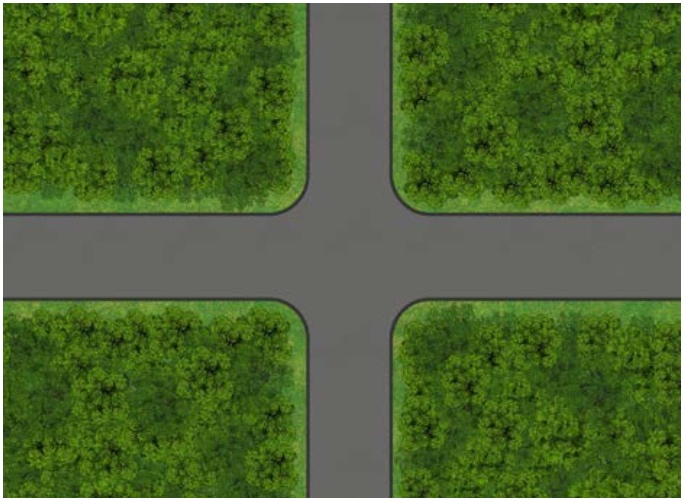
1. Uncontrolled (unmarked) crossroads
This is the most dangerous type of crossroads because nobody has priority. Approach slowly and look in all directions well before reaching the intersection.
Make eye contact with approaching drivers and signal your intentions clearly. Use your mirrors, proceed only when you are certain it is safe, and always be ready to stop. If you are in any doubt, hold back.
Pedestrian crossings have priority. As a general rule, give way to traffic already in the junction, but never assume other drivers will do the same.
- Nobody has priority by law—never assume another driver will yield
- Slow down early and keep your foot covering the brake pedal
- Look in every direction and make eye contact with other drivers
- Give way to pedestrians and vehicles already inside the junction
2. Controlled crossroads (Give Way or Stop lines)
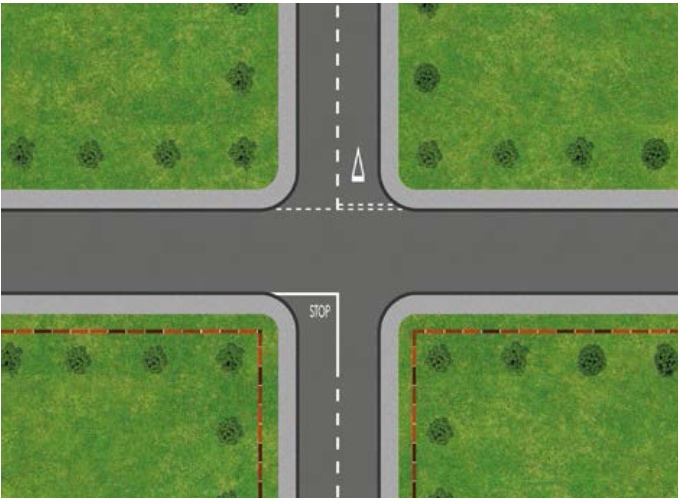
These crossroads have Give Way lines or occasionally a solid Stop line on the minor road approaches.
At a Stop line, you must come to a complete stop before you observe. Apply the handbrake if needed to secure the car before making your checks.
Take extra care when emerging because visibility is usually restricted by walls, hedges, or parked cars. Signal your direction clearly and proceed only when it is safe to do so.
- Come to a complete stop at a Stop line before moving forward
- Use the handbrake if paused on a gradient or waiting for traffic
- Take extra time to observe because visibility is often restricted
- Signal clearly and emerge only when your path is fully clear
3. Traffic-light controlled crossroads
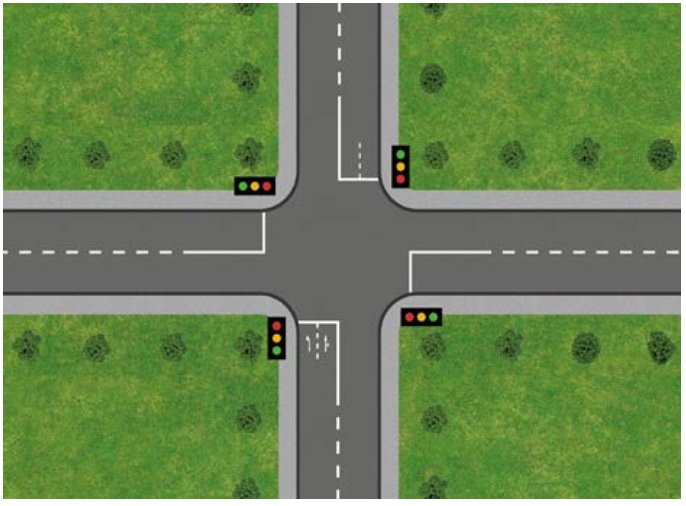
On your approach, plan your lane and get into position early. Follow road markings and overhead lane signs.
If you stop at the lights, check your door mirrors before moving off. Cyclists and motorcyclists can easily catch you up and filter down either side.
When changing direction, look all ways first. Another road user may have jumped the lights, or the signals might not be working correctly. If the lights have failed, treat the junction as an uncontrolled crossroads.
- Choose and take your lane early on the approach
- Check door mirrors before moving off for filtering two-wheelers
- Look all ways before turning in case someone runs a red light
- Treat the junction as uncontrolled if the traffic lights have failed
4. Crossroads with a yellow box junction
Do not enter the yellow box unless your exit road is clear. If traffic ahead stops and traps you on the grid, you commit an offence.
The key exception applies when turning right: you may enter and wait in the box if you are held back only by oncoming traffic, or by other vehicles waiting to turn right.
Look ahead early on approach. Work out whether the car in front will clear the box and leave you enough room to follow without sitting on the markings.
- Only enter the box when your exit road has space for your vehicle
- You may enter and wait when turning right, held only by oncoming traffic
- Judge following distance so you never get stranded over the markings
5. Dealing with crossroads from a major road
When driving through on the major road, glance right and left for vehicles pulling out in front of you.
If you and an oncoming driver both want to turn right, try the offside to offside method explained below. On small, narrow roads you may have to go nearside to nearside instead.
On 30mph roads, use the walk-across rule: if you could comfortably walk across the road, you have enough time to drive across.
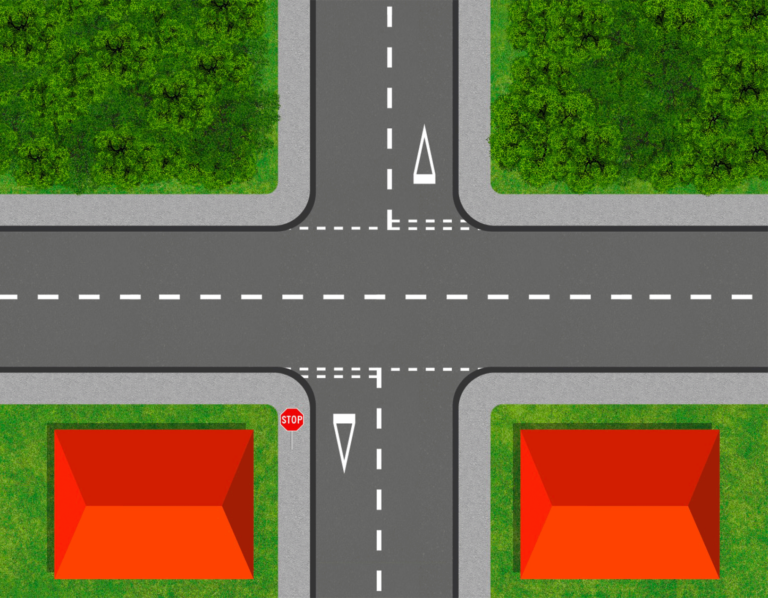
6. Dealing with crossroads from a minor road
Use the MSPSL routine on approach exactly as you would at a standard T-junction. Control your speed, select the right gear, and prepare to stop.
The key difference is the Look phase. Your minimum observations are right, left, ahead, and then right again before you pull out. If your view is restricted, repeat the whole observation cycle.
- Apply MSPSL in good time just like approaching a T-junction
- Minimum observations: look right, left, ahead, then right again
- Repeat the scanning cycle if your view is restricted by obstacles
- Emerge smoothly only when both crossing streams and oncoming lanes are safe
Work out which type of crossroads you are approaching as early as you can: it decides who has priority and how you handle it.
Turning Right at a Crossroads: Offside to Offside or Nearside to Nearside
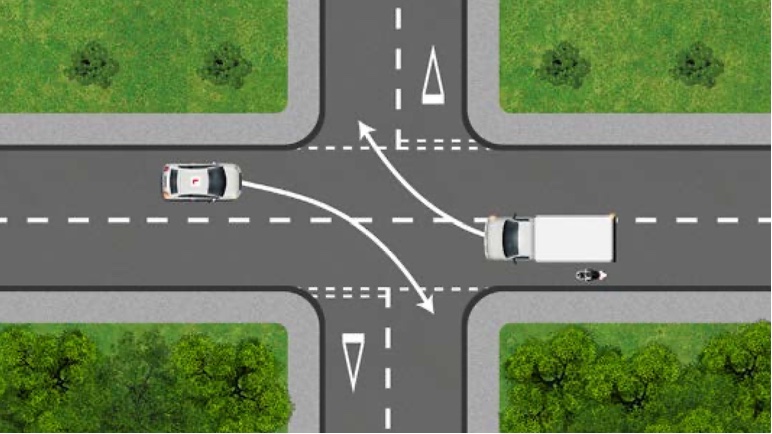
When you and an oncoming driver both want to turn right, you can pass in one of two ways.
1. Offside to offside explained
This is the safest way of turning right at the same time as another road user. If the crossroads is wide enough, you can usually pass the other vehicle and turn behind each other, driver's side to driver's side.
Passing behind keeps your forward view of oncoming traffic open. You can clearly see approaching cars, motorcycles, and cyclists before crossing their lane.
- Vehicles pass driver's side to driver's side behind each other
- Keeps your forward view of oncoming traffic open and clear
- Safest method whenever junction width and layout permit
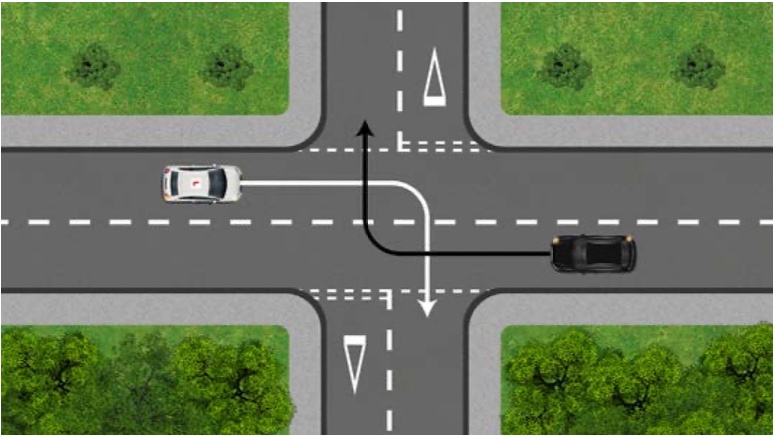
2. Nearside to nearside explained
This method is more dangerous because you turn in front of each other, passenger side to passenger side. The other car blocks your view of straight-ahead oncoming traffic.
Normally only do this when you can see fully down the road you are turning into. If you cannot see fully into the minor road, make eye contact with the other driver and work out who turns first. If in doubt, hold back.
- Vehicles turn in front of each other, passenger side to passenger side
- The opposing car creates a blind spot that hides oncoming vehicles
- Establish eye contact and decide who turns first
- Hold back if your view into the crossing stream is obscured
3. Watch for corner-cutters on right turns
When positioning to turn right, be alert to oncoming drivers who cut the corner by steering prematurely across the give-way lines or centre markings. If an approaching driver begins cutting the corner towards your position, stop cleanly before your point of turn, hold back, and allow them to clear rather than forcing an evasive swerve.
Equally, ensure your own vehicle does not cut the corner: drive straight forward to the centre point of the intersection before beginning your steering lock, keeping your tyres strictly in your own lane until you cross.
- Hold back if an oncoming vehicle cuts across the junction markings
- Drive to the centre of the intersection before turning the steering wheel
- Never steer diagonally across oncoming lanes or clip the side-road kerb
Crucial observation message: turning right nearside-to-nearside hides oncoming vehicles. You must check blind spots on BOTH sides of the car, keep all-round observation active (right, ahead, left, right again), and never emerge until your line of sight is totally clear.
Syllabus, Highway Code & Test Requirements
How this lesson aligns with the official national driving standards and practical test assessments in Great Britain.
- Approach all types of crossroads and staggered junctions using the MSPSL routine at a safe, controlled speed in an appropriate gear.
- Identify junction priority correctly from road signs, road markings, traffic signals, and geometric layout.
- Apply effective, continuous all-round observation, checking blind spots on both sides of the car before entering, crossing, or emerging.
- Select and maintain the correct lane and road position when turning left, turning right, or continuing straight ahead.
- Demonstrate safe judgement between offside-to-offside and nearside-to-nearside right turns.
Highway Code: Using the road – Junctions (rule 170)
Take extra care at junctions. Watch out for pedestrians crossing or waiting to cross, cyclists, and motorcyclists. Follow give way and stop rules strictly.
Highway Code: Using the road – Crossroads
Rules on approach speed, positioning, giving way, and the difference between offside-to-offside and nearside-to-nearside right turns.
Highway Code: Using the road – Box junctions
Statutory regulation prohibiting entry into a yellow box junction unless your exit is clear, except when turning right and held only by oncoming vehicles.
Highway Code: Using the road – Unmarked crossroads
Guidance confirming that no one has automatic priority at an unmarked crossroads; all road users must proceed with extreme caution.
- Junctions – Observation: The single most common reason for driving test failure nationwide. Assessed on approach, crossing traffic streams, checking dual-side blind spots, and emerging from minor roads.
- Junctions – Turning right: Assessed on positioning, gap judgement in oncoming traffic, and offside versus nearside procedure.
- Junctions – Approach speed and control: Assessed on braking progressively using MSPSL and selecting the correct gear before give-way or stop lines.
Practical Routine: Approaching and Negotiating Crossroads (MSPSL)
Follow the structured MSPSL (Mirrors, Signal, Position, Speed, Look) and LADA (Look, Assess, Decide, Act) routine to negotiate crossroads and staggered junctions with calm precision.
Check your interior mirror well before the junction to assess the speed and proximity of following vehicles. If turning left or right, immediately follow with the corresponding exterior door mirror (left door mirror for left turns, right door mirror for right turns). If proceeding straight ahead, keep the interior mirror check active.
Apply an unambiguous indicator signal roughly 3 to 5 car lengths before the turn if you are turning left or right. Do not signal if going straight ahead. Ensure your signal cannot be misinterpreted as intending to turn into an earlier driveway or private entrance.
Establish your road position early: for turning left, stay approximately 1 metre from the left kerb following the curve; for turning right, position just to the left of the centre line or into dedicated right-turn feeder bays; for straight ahead, maintain a central position in your lane without drifting.
Brake progressively on the straight approach. At an open crossroads where priority is clear and the way is safe, select 2nd gear at 10–15 mph so hands remain settled on the wheel. If the crossroads is closed, unmarked, or governed by a STOP line or red light, brake earlier, stop completely if required, and engage 1st gear.
This is the most critical step. Observations at crossroads require full all-round coverage: look right, ahead, left, and right again. Check blind spots on BOTH sides of the car—not just one side—by leaning your head and shoulders to see past windscreen pillars and door frames. Watch for oncoming right-turners, crossing pedestrians, cyclists, and traffic emerging from side roads. Assess gaps, decide whether your path is clear, and act smoothly.
When turning right opposite an oncoming vehicle, establish whether you are turning offside-to-offside (behind each other) or nearside-to-nearside (in front of each other). If nearside, creep forward slowly until you can see past the other vehicle. If emerging from a minor road, confirm safe gaps in all crossing streams simultaneously before moving out.
Steer cleanly into your target lane without cutting corners or swinging wide. Cancel your indicator promptly once straightened, check your interior mirror to monitor traffic on the new road, and build normal road speed smoothly.
Crossroads Visualisation and Dual-Side Observation Drill
A structured mental mapping and physical observation exercise to build fast recognition of junction types, offside/nearside setups, and dual-side blind spot checks.
Practice Steps
Core Essentials & Examiner Criteria
What you must get right every time, paired with what the driving examiner marks on your practical test.
What You Must Get Right
Always apply the MSPSL routine (Mirrors, Signal, Position, Speed, Look) well before reaching any crossroads.
Poor observation causes the most crossroads accidents: check blind spots on BOTH sides of the car, every single time.
Scan all approaches systematically: Right, Ahead, Left, and Right again; repeat continuously if your view is restricted.
At an unmarked crossroads, no one has legal priority; approach in 1st or 2nd gear, be ready to stop, and make eye contact.
You must come to a complete stationary halt at every octagonal STOP sign and line, regardless of road conditions.
Do not enter a yellow box junction unless your exit is clear, except when turning right and held back only by oncoming vehicles.
Offside-to-offside right turns are safer because you pass behind each other, keeping forward visibility of oncoming traffic open.
When turning right nearside-to-nearside, creep slowly and look past the other car's rear pillar for concealed oncoming traffic.
What the Examiner Looks For
Disciplined use of the MSPSL routine on approach, braking smoothly in good time and selecting the right gear.
Thorough, continuous all-round visual scanning covering right, ahead, left, and right again before crossing or emerging.
Checking blind spots on both sides of the car to ensure cyclists, motorcyclists, and pedestrians are not missed.
Correct lane positioning without cutting right-hand corners or swinging wide on left turns.
Accurate judgement of safe gaps in oncoming traffic without causing any other road user to slow down, swerve, or stop.
Strict obedience to STOP lines, give-way markings, traffic lights, and yellow box junction regulations.
Common Mistakes, Test Failures & Safety Tips
Understand how small slips become driving test faults, and how to keep every manoeuvre safe.
Common Learner Mistakes
Checking only one blind spot or single-side glances
Looking only to the right when emerging, or failing to check blind spots on both sides of the vehicle where cyclists and pedestrians may be approaching.
Tunnel vision on the major road
Focusing exclusively on crossing traffic while failing to monitor oncoming vehicles that are preparing to turn right across your path.
Blind right turns in nearside-to-nearside setups
Committing to turn right in front of an opposing car without creeping forward to check for hidden oncoming cars, motorbikes, or cyclists masked behind it.
Entering yellow box junctions with a blocked exit
Following the vehicle ahead onto the yellow criss-cross grid when traffic beyond the junction is stationary, leaving your car blocking crossing traffic.
Assuming priority at unmarked crossroads
Driving across an unmarked crossroads without slowing down because you assume your road is the major road or that you arrived first.
Essential Safety Tips
Check blind spots on both sides of the car
Never settle for a single mirror glance. Look over both shoulders and lean past your windscreen pillars to eliminate blind spots on both the left and right.
Look twice for two wheels
Cyclists and motorcyclists are narrow and easily hidden by vehicle pillars, trees, or opposing cars turning right. Always double-check before committing.
Never rely purely on indicators or flashing lights
An oncoming car indicating right might have an accidental signal running, or might turn into a different entrance. Confirm their speed and steering angle before moving.
Never race an amber light
At traffic lights, prepare to stop smoothly when amber shows. Accelerating to beat the change invites high-speed side-impact collisions.
Double-check staggered side roads
At a staggered junction, scan both offset mouths independently: a vehicle emerging from the second offset side road can cross your path unexpectedly.
Common Causes of Test Failure
How driving examiners categorise errors under the DVSA marking system:
Minor (Driving Faults)
Not potentially dangerous, but marked if repeated.
Approaching slightly too quickly but stopping safely
Braking firmer than necessary before a give-way line due to late speed adjustment, but remaining in control and not crossing the line.
Hesitation when priority is clear
Stopping unnecessarily on a major road at an open priority crossroads when no conflicting vehicles are present.
Serious Faults
Potentially dangerous; results in a test failure.
Inadequate observation before emerging or crossing
Pulling out from a give-way line or crossing the intersection without checking across all approaches, causing a crossing driver to brake.
Failing to check dual-side blind spots
Failing to check the blind spots on both sides of the car before turning across conflicting traffic or at complex intersections.
Blocking a yellow box junction
Entering a yellow box junction when proceeding straight ahead and becoming stranded across the grid due to queued traffic on the exit road.
Failing to stop at a STOP sign
Treating an octagonal STOP sign as a Give Way by rolling through without bringing the vehicle to a complete stationary halt.
Dangerous Faults
Actual danger to you, examiner, or other road users.
Cutting directly across oncoming traffic
Turning right blindly across the path of oncoming traffic, forcing another road user or the examiner to brake hard to prevent a collision.
Driving straight through an unmarked crossroads
Entering an uncontrolled crossroads at speed without slowing down or observing crossing vehicles, creating an immediate crash risk.
Question 1: What is the recommended approach routine when arriving at any crossroads or staggered junction?
Question 2: At an unmarked crossroads where neither road has road markings or signs, who has legal right of way?
Question 3: Why is poor observation at crossroads the leading cause of collisions and driving test failures?
Question 4: Under what circumstance may you legally enter and wait inside a yellow box junction?
Question 5: What is the key visibility difference between an offside-to-offside and a nearside-to-nearside right turn?
Question 6: What should you do if the layout of a crossroads forces you to turn right nearside-to-nearside?
Question 7: What does the walk-across rule mean when judging a gap to cross or turn at a crossroads?
Theory Test Topics for This Lesson
Reinforce what you have learned by practising official DVSA theory test revision questions.
Recognise crossroads warning signs, staggered junction priority symbols, traffic signal warnings, and octagonal STOP signs.
Practice on GOV.UKMaster priority rules for unmarked crossroads, yellow box junction regulations, and the difference between offside-to-offside and nearside-to-nearside right turns.
Practice on GOV.UKPrepare for questions testing dual-side blind spot checks, cyclist awareness at traffic lights, and pedestrian priority rules under Highway Code Rule 170 and Hierarchy of Road Users.
Practice on GOV.UK