Normal Roundabouts
Master the systematic MSPSL routine on approach to normal roundabouts, lane selection for every exit, giving way to traffic from your right, clockwise circulation, and safe signalling to exit.
Stuck on a term or acronym?
Look up DSSSM, MSPSL, clutch bite and more in plain English in the Jargon Buster.
Roundabouts: Keep It Simple
Four simple rules. Follow them every time.
Give way to traffic from your right.
Traffic approaching from your immediate right normally has priority, unless signs, signals or road markings tell you otherwise.
Never enter if someone is in the danger zone, 3 to 7 o'clock.
Don't pull out if another vehicle is approaching and your movement would cause them to brake, swerve or change direction. Only enter when there is a safe gap.
Pick the correct lane and stick to it.
Choose your lane before entering the roundabout and maintain your position. Avoid drifting across lanes or cutting across another vehicle's path.
Imagine a lane if there are no markings.
Even without painted lane markings, maintain a consistent path around the roundabout. If you're taking an exit to the left or straight ahead, generally keep towards the outside. Vehicles turning right may use the inside. Imagine a white line separating the two paths and avoid crossing into another vehicle's space.
Remember: Roundabouts are designed to keep traffic flowing, not bring everyone to a stop. Look early, anticipate other drivers, take safe opportunities and never force another driver to take avoiding action.
How to Spot a Roundabout Before You Reach It
Spotting a roundabout early gives you time to complete the MSPSL routine, study the lane destination signs, and select the correct approach lane well before you reach the hazard. Scan well ahead for these six progressive clues.
1. The triangular warning sign
Look for the standard red-bordered triangular warning sign featuring three black arrows arranged in a clockwise circular pattern. This sign gives you advance notice that a roundabout is coming up, typically positioned well ahead of the junction on faster single-carriageway and rural roads.

2. The map-type advance direction sign
Before the junction, you will usually see a large green (primary route) or white (non-primary route) map-type direction sign. The sign depicts the roundabout layout with a central circle and arms showing road numbers, place names, and exit directions.
Read this sign from bottom to top. Identify your destination and note which exit arm it corresponds to (e.g. 1st exit left, 2nd exit straight ahead, or 3rd exit right). This tells you your lane and signalling choice before you even see the tarmac markings.
- Look for your destination town, village, or road number on the arm diagram
- Identify the clock face position: before 12 o'clock, roughly 12 o'clock, or past 12 o'clock
- Note any dedicated lane boards or overhead gantry signs on multi-lane approaches
3. Road markings and approach paint
The road surface gives vital advance instructions as you draw closer. White hazard lines between lanes will lengthen, and dedicated lane arrows will appear on the approach carriageway.
Look for chevron markings or painted hatching separating approach lanes, painted destination text (such as 'A24 N' or 'TOWN CENTRE') in each lane, a large painted 'Give Way' inverted triangle in the centre of your lane, and finally the broken double white lines across your approach at the junction mouth.
- Painted directional arrows showing left, straight, or right options
- Lane text indicating specific destinations or bypass routes
- Hatched buffer zones that you must not enter unless safe and necessary
- The double broken white give-way line where your car must yield to traffic from the right
4. The physical layout, islands, and speed change
Scan the road landscape ahead for the physical geometry of a roundabout. You will spot a raised circular central island, often landscaped with grass, shrubs, directional chevron signboards (white arrows on blue rectangles or black chevrons on yellow backgrounds), or street lighting columns.
You will also see raised triangular splitter islands with reflective bollards separating entering traffic from exiting traffic. Look for statutory speed limit changes: approaches often drop to 30 or 40 mph, and the road curves laterally to encourage natural deceleration.
- Central island with directional chevrons showing the clockwise path
- Splitter islands on the left with blue arrow bollards directing you left of the island
- Street lights clustered around the perimeter of the junction
- Deflection in the carriageway designed to slow your approach speed
5. Other traffic's behaviour and indicators
Watch the movement of other vehicles well ahead of you. Brake lights activating across multiple lanes, cars positioning into distinct lane streams, and flashing indicators give immediate confirmation of a roundabout ahead.
Observe vehicles circulating on the roundabout itself to gauge current traffic density, and look at vehicles queueing or merging at other entry arms to anticipate when gaps will open up.
- Brake lights illuminating simultaneously across two or more lanes ahead
- Traffic circulating horizontally across your forward field of vision
- Vehicles on your right slowing or indicating to leave at your approach arm
6. Open or closed junction?
As soon as you spot the roundabout, judge whether the junction is open or closed before starting the MSPSL routine. Remember: open or closed describes sight lines only. An open junction does not mean the roundabout is empty; it can still be busy.
An open junction gives you clear visibility in both directions well before the give-way line. A closed junction has poor sight lines where your view is obstructed: remember BBBV, which is Buildings, Bushes, Bricks (walls) and Vehicles (such as high-sided vans or queueing traffic).
Your sight lines dictate your approach speed. At an open junction with clear sight lines, you may approach considerably faster (while remaining controlled and ready to stop). At a closed junction with obstructed views, you must approach much slower, possibly using 'peep and creep' or coming to a dead stop until visibility improves.
- Open or closed describes sight lines and visibility, never whether the roundabout is clear or busy
- Open: clear sight lines allow a smoother, considerably faster approach in second gear if a safe gap is identified
- Closed: BBBV (Buildings, Bushes, Bricks/walls, Vehicles) blocks your view, demanding a much slower crawl, 'peep and creep', or a complete stop
- Spot the signs and assess the sight lines as the vital first stage before beginning mirror checks and preparation
Spot the roundabout signs and judge whether the junction is open or closed first, then start the MSPSL routine with Mirrors.
Choosing Your Lane and Signalling for Each Exit
Unless road markings, signs, or lane arrows direct you otherwise, apply the standard UK Highway Code rules for lane selection and indicator signals.
1. Turning left (first exit, before 12 o'clock)
When taking an exit to the left (normally the first exit):
On approach: check your interior mirror and left door mirror. Signal left in good time. Position your vehicle in the left-hand lane.
On the roundabout: keep in the left lane and maintain your left signal throughout. Watch for pedestrians or cyclists near the exit mouth.
Leaving: stay in your lane, check your mirrors, cancel your signal once safely into the new road, and build up normal road speed.
- Approach lane: left-hand lane
- Approach signal: left indicator
- On roundabout: stay left, keep signalling left
- Exit: check mirrors and cancel signal once on the new road
2. Going straight ahead (intermediate exit, roughly 12 o'clock)
When taking an intermediate exit that lies straight ahead or roughly opposite your approach:
On approach: check your interior mirror. Do not signal on approach—signalling either left or right on approach would mislead traffic. Position your vehicle in the left-hand lane, unless lane markings or road signs indicate that the left lane is for left turns only.
On the roundabout: stay in the left-hand lane (or intermediate lane if marked). Maintain lane discipline and do not drift across central lane markings.
Leaving: as you pass the exit immediately before the one you want, check your interior mirror and left door mirror, then apply a crisp left signal. Guide the car smoothly into the exit lane.
- Approach lane: left-hand lane (unless signs indicate otherwise)
- Approach signal: no signal on approach
- On roundabout: stay in your lane, keep speed controlled
- Exit: check interior and left door mirrors, signal left after passing the exit before yours
3. Turning right (exit past 12 o'clock)
When taking an exit to the right (past 12 o'clock, commonly the 3rd exit or later):
On approach: check your interior mirror and right door mirror. Signal right in good time. Position your vehicle in the right-hand lane.
On the roundabout: enter into the inner (right-hand) lane next to the central island. Maintain your right signal while circulating.
Leaving: as you pass the exit immediately before the one you want, check your interior mirror and left door mirror, then change your signal from right to left. Guide your car smoothly across towards your exit, watching for vehicles alongside in the left lane.
- Approach lane: right-hand lane
- Approach signal: right indicator
- On roundabout: circulate in the right lane next to the island, keeping right signal active
- Exit: check interior and left mirrors, signal left after passing the exit before yours, and cross cleanly into the exit
4. Going full circle (returning the way you came)
When making a U-turn or returning on the same road (e.g. if you missed a turning or are directed by signs):
On approach: check interior and right mirrors, signal right, and position in the right-hand lane.
On the roundabout: stay close to the central island in the right lane with your right signal on. Be extra watchful of vehicles entering from other arms who may not anticipate a vehicle going all the way round.
Leaving: as you pass the exit immediately before your return road, check your interior mirror and left door mirror, signal left, and move safely across to exit.
- Approach lane: right-hand lane with right indicator
- On roundabout: stay in the inner right lane with right indicator active
- Exit: check mirrors and signal left after passing the exit prior to your return arm
- Observation: be alert for other drivers pulling out in front of you from subsequent entry arms
5. Long vehicles and vulnerable road users
Be aware that long vehicles (such as buses, articulated lorries, and car transporters) need extra room to negotiate roundabouts. They may straddle two lanes on approach or circulate in the left lane even when turning right, because their trailer sweeps wide. Never attempt to draw alongside or undertake a long vehicle on a roundabout.
Cyclists, horse riders, and motorcyclists may also choose to stay in the left-hand lane all the way around the roundabout for safety, even when turning right. Look out for them and give them plenty of room.
- Give long vehicles wide clearance; do not drive alongside them on circulation
- Anticipate that HGVs may take a different line to prevent their rear wheels clipping kerbs
- Watch for cyclists in the left lane who may continue across your exit path
Signs and markings always take precedence: if road markings allocate the middle or right lane for straight ahead, follow the tarmac markings rather than general rules.
Roundabout Blockers and the Danger Zone
A blocker can help you find a gap at a busy roundabout, but it never tells you to go. This section shows how to read blockers, judge whether the gap they create is safe, and keep the danger zone (3 o'clock to 7 o'clock on the clock face) in view.
1. What Is a Roundabout Blocker?
A roundabout blocker is traffic already on the roundabout, or queueing to join it, that stops vehicles from your right reaching your entry. When the roundabout fills up, this can open a temporary gap for you to join.
Picture a queue of people walking past a doorway. While they keep coming, you cannot step in. When the flow slows or stops, a space appears. That is what a blocker does.
However, a blocker does not mean 'go'. It only creates an opportunity, and you must still judge it safely.
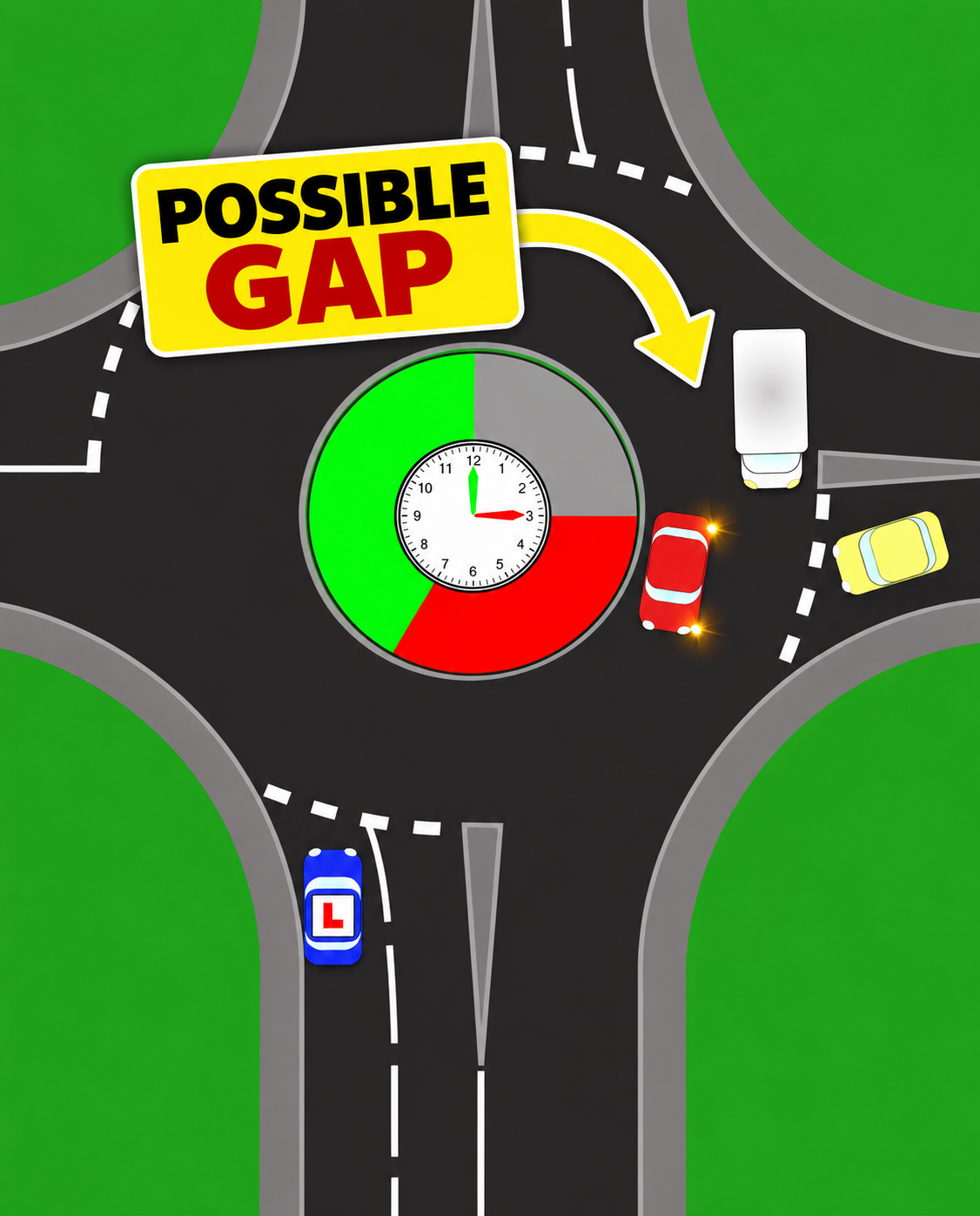
Look at the picture. The red car is in our danger zone, between 3 and 7 o'clock on the clock face, so normally we would not be able to go.
But look at what the red car is telling us. Its road position shows it is turning off, its wheels are angled to follow the exit, and it is indicating. Together these give a fairly clear sign that it is going to take the exit in front of us.
If our car is clear and ready to go, we can probably move off. We keep our eye on the red car to make sure it really does continue down the exit.
This red car is our friend. It is a blocker, also called a shield, because it stops the yellow car from going. That helps us make progress on the roundabout.
Three clues tell us the red car is a genuine blocker:
- Road position: the car is placed to take the exit in front of us
- Wheels: they are turning to follow the exit, not carrying on round the roundabout
- Indicator: the driver is signalling that they are leaving
2. When a Blocker Creates a Safe Gap
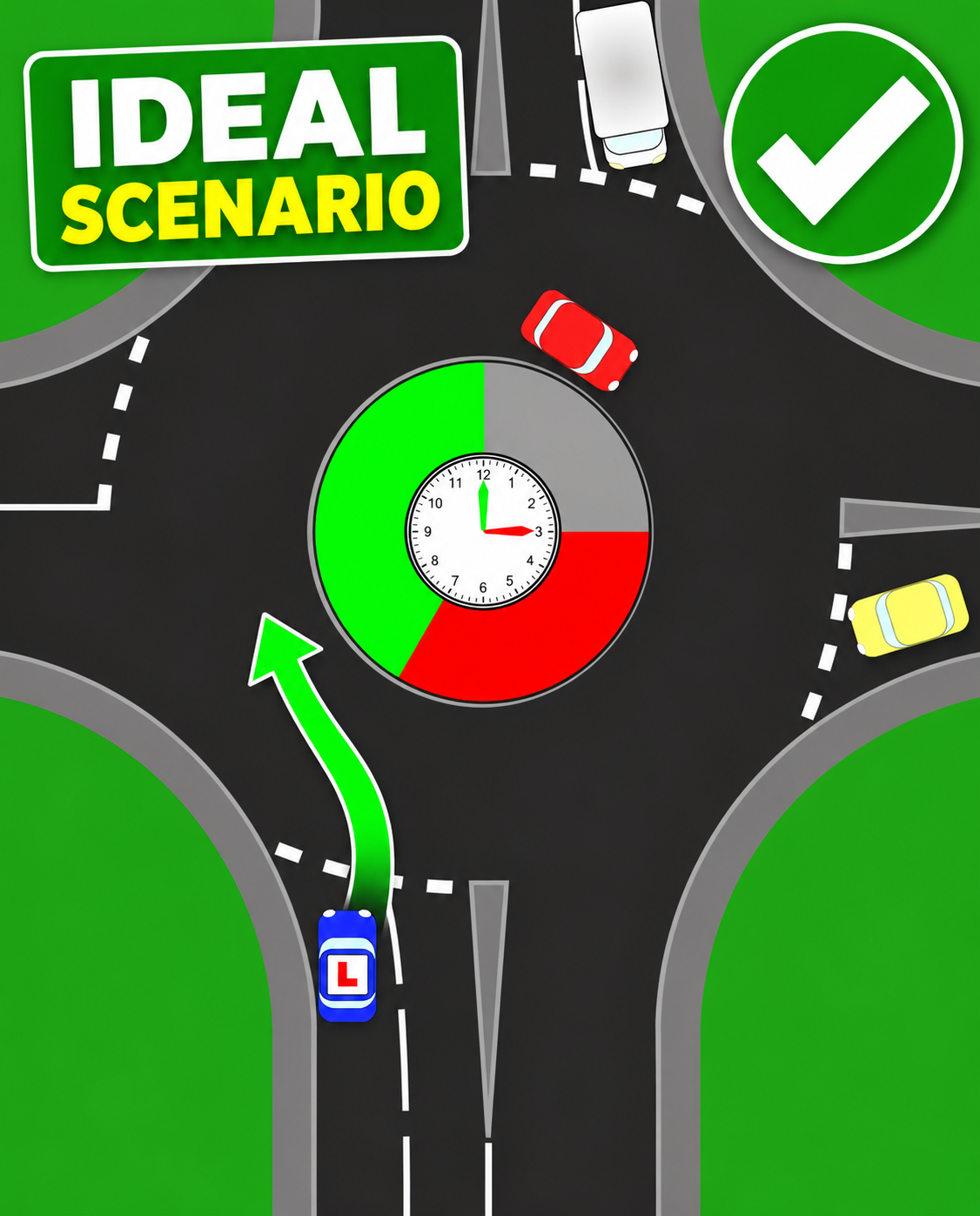
Not every gap a blocker creates is safe. This is where your judgement comes in. A safe gap has three features:
Look at the picture: our danger zone is clear. However, a yellow car is waiting at the junction on our right and might move into the danger zone. On a roundabout we give way to traffic from the right, so normally we might stop and give way to the yellow car.
But the red car is already on the roundabout, so it has priority and right of way. The red car is our friend, our teammate: it will block the yellow car from going, so it becomes our blocker. So not only is our danger zone clear, we also have a blocker stopping another car entering the roundabout.
This is a busy roundabout, but this is sometimes as good as it gets: a really good, possibly ideal, scenario to go.
When traffic flows smoothly and your entry path stays clear, you can take advantage of the blocker to join without delay.
The key question is: will this gap still be there by the time I move? If you are not sure, it is usually best to wait.
- Time: there is enough room to move off smoothly
- Stability: the gap is not about to close
- No impact: nobody else has to brake or change direction because of you
Syllabus, Highway Code & Test Requirements
How this lesson aligns with the official national driving standards and practical test assessments in Great Britain.
- Approach roundabouts using the systematic MSPSL routine at an appropriate speed in the correct gear.
- Select and maintain the correct approach and circulatory lanes according to intended exit, road markings, and signs.
- Comply strictly with give-way rules by yielding priority to traffic approaching from the right.
- Signal intentions clearly and unambiguously on approach and when preparing to exit.
- Maintain continuous all-round observation, checking mirrors and blind spots for vulnerable road users and drifting vehicles.
Highway Code: Roundabouts (rules 184–190)
Rules covering approach planning, lane choice, give-way priority to the right, signalling on entry and exit, and circulatory lane discipline.
Highway Code: Signals to other road users (rules 103–106)
Signalling intentions in good time without misleading other drivers, and cancelling indicators promptly after completing manoeuvres.
Highway Code: Hierarchy of Road Users (rules H1, H2, H3)
Giving way to pedestrians crossing or waiting to cross zebra or informal crossings at roundabout entry and exit roads.
Highway Code: Vulnerable road users at roundabouts (rule 187)
Taking extra care for cyclists, motorcyclists, and horse riders who may stay in the left lane while travelling around the roundabout.
- Assessed under 'Junctions – Roundabouts' for approach speed, lane selection, and circulatory lane discipline.
- Assessed under 'Junctions – Observation' for judging safe gaps from the right and checking mirrors before exiting.
- Assessed under 'Use of mirrors – Change of direction' before altering course, changing lanes, or exiting.
- Assessed under 'Signals – Correct / Timed' for approach signals and the exit signal after passing the penultimate exit.
Practical Routine: Approaching and Negotiating Roundabouts
The routine begins by spotting the roundabout and assessing the sight lines (open vs closed) with your eyes and mind, before systematically applying the structured Mirrors, Signal, Position, Speed, and Look (MSPSL) sequence.
Scan well ahead before taking any physical preparation action. Spot the clues that confirm a roundabout is coming: the triangular warning sign with clockwise arrows, map-type advance direction boards, road markings (hazard lines, painted destination text, give-way triangles), and the raised central island. Next, assess whether the junction is open or closed. Remember that open or closed describes sight lines only: an open junction does not mean the roundabout is empty; it can still be busy. If the junction is open (clear view in both directions), you may approach considerably faster, though still controlled and ready to stop. If the junction is closed (view obstructed by BBBV: Buildings, Bushes, Bricks/walls, or Vehicles), you must approach much slower, prepared to use 'peep and creep' or come to a dead stop until your visibility improves.
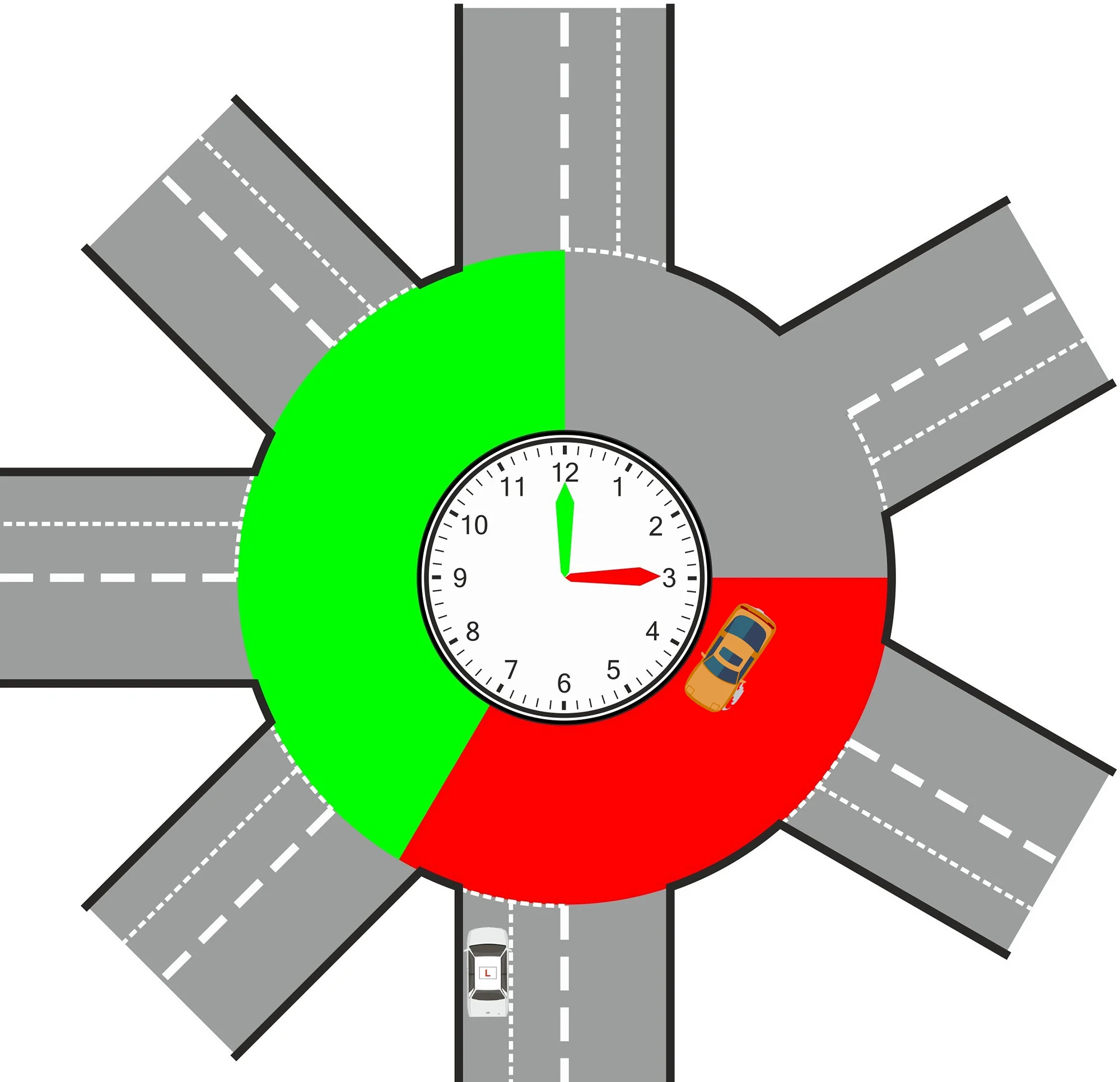
The Danger Zone: 3 o'clock to 7 o'clock
To judge roundabout priority easily, picture the roundabout as a clock face with your approach entry at 6 o'clock. The positions from 3 o'clock to 7 o'clock represent clock face positions, not times of day. If there is nothing in our danger zone from 3 o'clock to 7 o'clock, it is the easiest action to take. The circulation path is clear and it is safe to go.
If there is a car in the danger zone, the simplest rule at a roundabout is that we give way and wait at the give-way line (the stop line marked by double broken white lines). We yield priority to vehicles circulating from our right until a safe gap appears.
Slowing on approach is a more advanced technique: if we adjust our speed and slow down on approach, so that we may even keep rolling, that is even better. For example, we see the roundabout ahead and slow down early; seeing a car in the danger zone, we ease off to perhaps 5 to 10 mph in second gear, let that car pass across our front, and keep rolling smoothly into the roundabout once we get good at roundabouts. Remember that this rolling technique is a skill to build up to with practice; stopping cleanly and giving way at the line is always the safe, reliable default.
Well before reaching the roundabout, check your interior mirror to assess following traffic speed and distance. Follow immediately with the appropriate exterior mirror: left door mirror if turning left, or right door mirror if turning right. If going straight ahead, check the interior mirror.
Apply your indicator in good time: signal left for the first exit; do not signal for an intermediate straight-ahead exit; signal right for any exit past 12 o'clock. Ensure your signal is given before braking so following traffic understands your plan.
Guide your vehicle into the correct lane before you start braking. Use the left lane for turning left or straight ahead; use the right lane for turning right or full circle (unless painted road markings or destination boards specify otherwise). Never straddle lane lines on approach.
Adjust your approach speed based directly on your earlier open or closed decision. At an open junction with clear sight lines, you can approach considerably faster down to around 10–15 mph in second gear, ready to blend smoothly if a safe gap exists from the right. At a closed junction where BBBV obstructs your view, you must approach much slower, selecting second or even first gear, ready to use 'peep and creep' or come to a dead stop at the give-way line until you have a clear view.
Cycle through Look, Assess, Decide, Act as you roll towards the line. Look early to your right: scan across the roundabout arms for oncoming circulating traffic. Look ahead into your entry lane. Assess the speed and indicators of approaching vehicles. Decide early: 'Can I go, or must I stop?' If clear, proceed smoothly without stopping. If a vehicle is approaching from the right, stop cleanly behind the double broken white lines, apply the handbrake if pausing for a while, and select first gear.
The Three S's: Never Pull Out With a Car in Your Danger Zone
The simplest rule of roundabouts: if there is a car in your danger zone (3 o'clock to 7 o'clock on the clock face, clock positions not times of day), don't go.
Pulling out in front of someone breaks one of the major rules of driving, the three S's: you make another driver Swerve, Slow down or Stop.
Failing to give way to traffic from the right and pulling out with a car in your danger zone is a big likelihood of a test failure. Causing someone to stop or swerve is likely to be an immediate fail; causing someone to slow down is at least a minor fault and can be marked as serious or dangerous at the examiner's discretion.
Once you enter the roundabout, travel clockwise. Keep strictly within your lane dividers and do not cut across painted lines. Monitor vehicles in adjacent lanes in case they drift, watch for long vehicles swinging wide, and keep a lookout for cyclists in the left lane.
Not All Roundabouts Have Lanes: Keep to Your Side
Not all roundabouts have lane markings.
If there are two lanes going into a roundabout, try to make two lanes on the roundabout. If you are turning left, taking the first exit or going straight on, stay in the left lane and hug the outside kerb of the roundabout.
If you are turning right, or taking any exit past 12 o'clock, and there were two lanes on the way in, hug the inside of the roundabout, making a theoretical lane two.
No road markings does not mean you can use the whole road. Keep to the left for the first exit or straight on; keep firmly to the right, on the inside of the roundabout, for anything past 12 o'clock.
As your vehicle passes the exit immediately before the one you want, check your interior mirror and your left door mirror. Apply a clear left signal. Guide your car smoothly into the exit lane without cutting across other traffic. Scan the exit road for crossing pedestrians, cancel your signal once straight, and accelerate up to the speed limit.
Parked-Car Routine and Roundabout Mental Mapping Drill
A structured mental mapping and physical observation exercise to build instinctive lane selection, approach footwork, and timely exit signalling.
Practice Steps
Core Essentials & Examiner Criteria
What you must get right every time, paired with what the driving examiner marks on your practical test.
What You Must Get Right
Spot the roundabout signs and assess sight lines (open vs closed) as the first stage before starting MSPSL mirror checks.
Remember that open or closed refers strictly to sight lines: an open roundabout is not necessarily empty and can still be busy.
Adjust approach speed to visibility: approach faster on open sight lines if safe, but much slower on closed junctions, using peep and creep or stopping if view is restricted.
Always apply the MSPSL routine well before reaching the give-way line of any roundabout.
Give way to all traffic approaching from your immediate right unless signs, signals, or lane markings state otherwise.
Unless signs or road markings say otherwise: left lane for left turn and straight ahead; right lane for right turns and full circle.
Never signal on approach when taking an intermediate exit straight ahead (roughly 12 o'clock).
Always check your interior mirror and left door mirror, then signal left, as you pass the exit immediately before the one you want.
Stop at the give-way line only when necessary; if your view is clear and a safe gap exists from the right, merge smoothly in second gear.
Stay strictly in your marked lane while circulating; never drift across lane markings or cut the corner of central islands.
Watch out for pedestrians crossing at entry and exit roads, cyclists in the left lane, and long vehicles requiring extra turning room.
What the Examiner Looks For
Approaching at a controlled speed in second gear with good planning, ready to proceed if clear or stop smoothly if occupied.
Correct lane selection on approach matching destination signs, painted arrows, or standard Highway Code rules.
Accurate gap judgement from the right, avoiding both reckless entry in front of traffic and undue hesitation at empty roundabouts.
Disciplined lane positioning throughout circulation without cutting across lane lines or drifting into adjacent traffic.
Timely exit procedures: checking interior and left mirrors and applying a left signal after passing the penultimate exit.
Awareness of vulnerable road users, including yielding to pedestrians crossing exit arms and watching for cyclists.
Common Mistakes, Test Failures & Safety Tips
Understand how small slips become driving test faults, and how to keep every manoeuvre safe.
Common Learner Mistakes
Wrong approach lane selection
Approaching in the right lane for a straight-ahead exit, or in the left lane for a right turn, when road markings do not authorise it.
Misleading approach signals
Signalling left or right on approach when intending to continue straight ahead, causing confusion for following and entering traffic.
Hesitation when the roundabout is clear
Coming to a complete stop at the give-way line when the roundabout is completely clear to the right, showing a lack of forward planning.
Failing to check left door mirror before exiting
Steering across from the inner circulatory lane to the exit without checking the left mirror for vehicles, cyclists, or motorbikes alongside.
Essential Safety Tips
Never trust a right indicator blindly
A driver circulating with their right signal on may intend to exit or may have forgotten to cancel their signal. Confirm their vehicle's speed and front wheel angle before pulling out.
Give heavy goods vehicles extra space
Articulated lorries and buses often need to straddle two lanes to get around the central island. Never drive along their blind side or squeeze alongside them on circulation.
Watch for pedestrians crossing at the exits
Under Highway Code Rule H2, pedestrians crossing or waiting to cross an exit road have priority. Slow down and be prepared to yield as you leave the roundabout.
Look twice for cyclists and motorbikes
Two-wheelers are narrow and easily hidden by window pillars. Cyclists frequently stay in the left-hand lane even when turning right; always give them room and never cut across their front wheel.
Common Causes of Test Failure
How driving examiners categorise errors under the DVSA marking system:
Minor (Driving Faults)
Not potentially dangerous, but marked if repeated.
Slightly late exit indicator
Applying the left exit signal only as the car enters the exit road rather than immediately after passing the penultimate exit, when no other traffic was directly affected.
Momentary hesitation at a clear give-way line
Pausing briefly at the give-way line when a safe, generous gap was available to the right, but proceeding without impeding following drivers.
Serious Faults
Potentially dangerous; results in a test failure.
Failing to give way to traffic from the right
Entering the roundabout and forcing a vehicle circulating from the right to brake or steer to avoid a collision.
Lane drifting across circulatory lanes
Drifting across marked lane dividers while negotiating the roundabout, cutting across the path of a vehicle in an adjacent lane.
Dangerous Faults
Actual danger to you, examiner, or other road users.
Pulling out into the direct path of circulating traffic
Pulling out from the give-way line directly into the path of an oncoming circulating vehicle, requiring the examiner to take physical control of the dual brake or steering.
Exiting without checking mirrors across an overtaking cyclist
Swerving towards an exit arm without checking the left door mirror, cutting off a cyclist circulating in the left lane and causing imminent danger.
Question 1: When approaching a roundabout, what does describing the junction as 'open' mean?
Question 2: How should you adjust your approach when approaching a 'closed' roundabout where BBBV (Buildings, Bushes, Bricks, Vehicles) obstructs your view?
Question 3: Under normal circumstances on a standard UK roundabout, to which traffic must you give way?
Question 4: Unless road signs or markings indicate otherwise, which lane should you normally choose on approach to turn left (first exit)?
Question 5: What signal should you give on approach when you intend to take an intermediate exit straight ahead (roughly 12 o'clock)?
Question 6: When should you apply a left indicator signal to leave a roundabout at an intermediate or right-hand exit?
Question 7: Why should you avoid driving alongside a long articulated lorry on a roundabout?
Question 8: Which lane should you normally take on approach when taking an exit to the right (past 12 o'clock)?
Question 9: What should you do if you are approaching a roundabout in second gear and you can see that the roundabout is completely clear to your right?
Question 10: Why might a cyclist or horse rider stay in the left-hand lane while travelling all the way around a roundabout to turn right?
Question 11: What critical mirror check must you make immediately before signalling and steering towards your exit from a roundabout?
Question 12: Under Highway Code Rule H2, what must you do if a pedestrian is crossing the exit road of a roundabout you are about to enter?
Question 13: What does a triangular road sign with a red border and three black arrows in a clockwise circle indicate?
Question 14: What should you do if you find yourself in the wrong lane as you circulate on a busy roundabout?
Question 15: When approaching a roundabout, what do painted lane destination arrows and road names on the tarmac tell you?
Theory Test Topics for This Lesson
Reinforce what you have learned by practising official DVSA theory test revision questions.
Study triangular roundabout warning signs, map-type advance direction boards, and painted give-way approach markings.
Practice on GOV.UKMaster priority to the right, lane selection for left, straight, and right exits, and exit signalling procedures.
Practice on GOV.UKPractise official theory questions regarding vulnerable road users in the left lane, lorry sweep paths, and pedestrian priority at exit roads.
Practice on GOV.UK